Sunday, April 21, 2013

OlyKraut Kaizen


Kaizen: Japanese for "improvement", or "change for the better" refers to philosophy or practices that focus upon continuous improvement of processes in manufacturing, engineering, and business management.

Sauerkraut: directly translated: "sour cabbage", is finely cut cabbage that has been fermented by various lactic acid bacteria

OlyKraut: Awesome, locally owned sauerkraut business in Olympia, Washington owned by one of my BGI classmates

This was the extent of my kaizen and sauerkraut knowledge at the BGI benefit auction last fall. However, it did not stop me from joining forces with two other classmates and bidding on a “training day” to learn how kaizen works when applied to a real world business. After our day long analysis at OlyKraut, I can now confidently say I know much more than I did at the auction.
Before ever setting foot in the OlyKraut kitchen, we heard an in-depth presentation where the owner explained her process and workflow, and how she viewed the critical tasks. It was great to get her perspective on what the challenges and opportunities were, and also develop a mental picture of what we might find. By going into the operation with a rough understanding of the process, it was much easier to plug in and observe.
And boy did we observe! Our awesome coach Megan gave us some tips and best practices of how to effectively observe so that we would actually be able to derive value from our observations. Initially, we all walked the facility, drawing out the physical layout of equipment, people, storage, and well, EVERYTHING. We drew out things that were not even part of the OlyKraut process/materials, but since they were in the space, they indirectly impact the process that OlyKraut can use.

Our observations started when the sauerkraut process started. With 5-7 people working in the warehouse, we had our hands full with observation opportunities, so Megan split us up to divide and conquer. There were two main tasks associated with observation of the first full batch being made. First was movement tracking (where does a worker physically move in the space and when), and second was timing. Armed with stopwatches and sketches, we were ready to go. However, as we watched the workers, it became apparent that it would be impossible to individually time each movement and how long it took (time to weigh a box of cabbage, time to move the box from the cart to the scale etc), so Megan threw us a tip: just start the watch and record the time a new action takes place. This way the time runs for the entire process, and recording becomes your main priority. It also takes away the chance you will forget to start/stop the watch.
So off we went. As we timed and mapped movement, Megan circulated around asking us for observations. We discussed a few items here and there, during the observation, but then really worked through change suggestions after we all came back together. Our main focus was identifying waste.
Waste: Any action, process, or product that adds cost without adding value, as perceived by the customer.

Using this definition, few major recommendations were obvious:

·        Workers worked incredibly hard and non-stop, but the cabbage was just sitting there
·        A piece of critical equipment was being used for two jobs, one which was not adding any value to the process
·        Lots of movement, walking in the process (35 minutes of our hours long observation of one worker was walking!)
·        Inefficient use of space
·        Opportunity for batching
·        Timing all of these actions gave us concrete numbers to justify previously held design assumptions driving the timing and current process were incorrect

Observing the sitting cabbage was a great place to start our conversation with OlyKraut. It is also a great topic for company implementers to frame our feedback to workers to minimize discomfort that we are out to call out their inefficiency. By focusing on observable waste, and process oriented recommendations, it is clear that it was the workspace configuration and flow of work creating waste, not a lack of their hard work.
We left OlyKraut a short list of recommendations for implementation, and it will be exciting to see how they play out over the next few months, and if the team of workers on staff will come up with more efficiencies of their own.
In the end, we hope our help can give extra efficiency to OlyKraut and extra boost its profitability!

Sunday, April 7, 2013

Publicly Traded vs. Private Companies


I have always been interested in learning more about fundamental difference between public and private companies. As second quarter of BGI rolled around, we were picking companies to investigate. Initially, my group selected a company that we thought was publicly held. It was not, which made our task of analyzing their financials nearly impossible. At the same time, I work for a company that is proud to be private. One of the first things I heard during new hire orientation was that “we do not have an exit strategy”…in other words, selling out was not on the table.

With public vs. private swirling in my head, I have been picking up on this difference in the news, and trying to figure out what role this distinction plays in how a company moves forward with sustainability.

This week, I heard a report on NPR regarding how a shareholder at Starbucks was outraged at the possible impact the company support of DOMA (the Defense of Marriage Act that supports same-sex marriage) had on it’s earnings. According to this shareholder, his profitability as an investor was tarnished by this “people” driven corporate value made public. Now, there is no conclusive evidence that this public support of homosexuality actually did have a direct impact on the stock price, but it made me think about the implications of other sustainability metrics, and how large (typically publicly held) companies can realistically move these items forward with shareholder opinion.

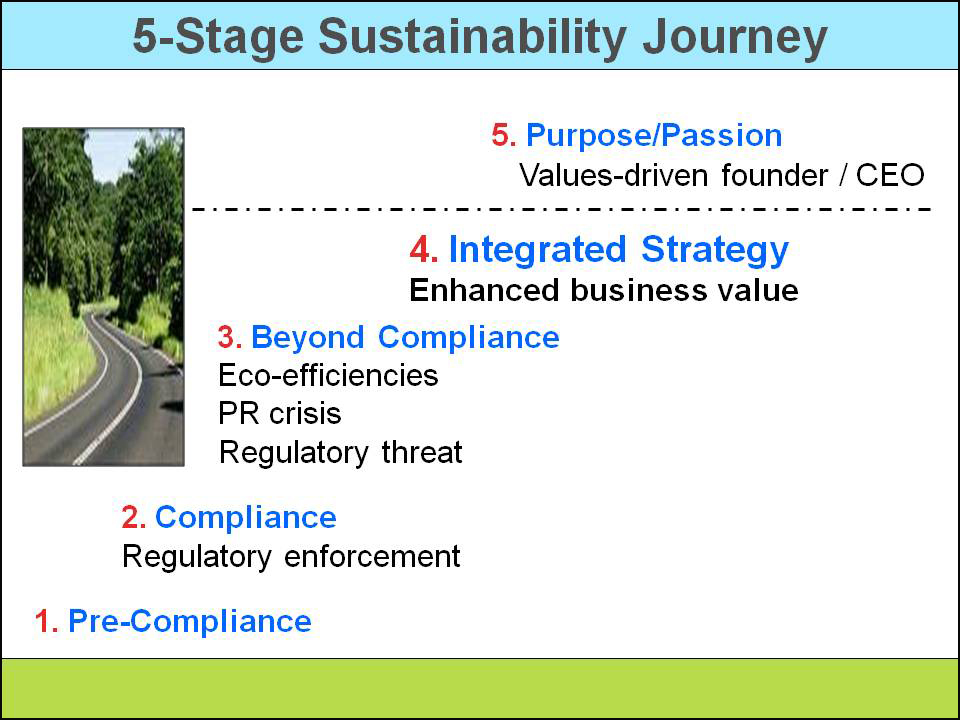
As we learned from Bob Willard, companies can be sorted into five stages of integrating sustainability into their daily operations. These range from the earliest and most reactive stage of pre-compliance, to the purpose driven sustainability companies that embody these values from the top-down and inside-out. I would say that Starbucks in relatively proactive in their sustainability goals, somewhere between stages 3 and 4 on Bob Willard’s diagram below.


As Starbucks (and other publicly traded companies) push towards more sustainable operations, they will be balancing the triple bottom line: people, planet and profit. In this delicate balance, where do owner/leader values fit in? We have learned from many examples (such as Ben & Jerry’s, Bob’s Red Mill) that when an owner founds a company with balancing these elements first, they are more likely to be in Stage 5, where these values permeate the company and all decisions. It seems possible that a company could move towards Stage 5 as they move up the ladder, but is it possible to achieve as a publicly traded company? I expect that this public vs. private ownership has much to do with a company’s ability to achieve top tier sustainable operations.

Why would this distinction be important? The example from Starbucks is a great one. Clearly the leadership values differ from some of those within their large group of shareholders. Since a key mechanism of publicly traded companies is responding to shareholder pressure, it sounds realistic that sustainability measures and values (of which “people issues” are a large part in the case of same-sex support) would be more likely to cave to shareholder values if they do not align with corporate values. This leaves an opening for influential decisions to be driven by outside people, potentially driving a company on a course different from it’s core values. I found it powerful that the Starbucks CEO responded to shareholders disapproval of company support for marriage equality can invest somewhere else. Schultz stated, “if you feel, respectfully, that you can get a higher return than the 38 percent you got last year, it’s a free country. You can sell your shares of Starbucks and buy shares in another company. Thank you very much.” It will take leaders with this personal drive to lead these publicly traded companies towards a value based, sustainable future.

I do make an assumption here, that companies will or do value sustainability, and are trying to push that agenda forward. For the purpose of this article, sustainability (people, planet and profit in balance) is the value proposition that I am hoping companies will protect. Clearly, not all companies value these things, but likely face challenges to whatever their value set when shareholders become involved once a public company.

In contrast to this is the company that I work for, which is privately held, and pursues direction based on the core values of our leadership team and CEO. These values have evolved over time, and are driving further and further to defining how we will embody sustainability in the future. Our mission has actually changed in the past two years to more specifically call out considerations for protecting the planet, a clause that had been missing in the past. 

We are not subject to shareholder input and responding to our values impacting profitability. Everyone with a stake in the company (as either an owner or employee) is reminded constantly that we answer to no one but ourselves and I believe that this will give us, and other private companies, more leverage to move the needle on a sustainable business future.

Over the course of the week, I considered the differences further, and came up with a possibility that perhaps the publicly traded companies may have an advantage as public perception continues to evolve. Public pressure can be incredibly powerful and could end up being the final push that move lagging companies to incorporate sustainable goals into their operations. Ultimately, I believe it is a societal value shift that needs to happen, and public and private companies will have their own paths to evolve with this shift. 

Saturday, February 23, 2013

Lunchables: An Oscar Meyer Case Study


The past two weeks have been all about operations. Lean manufacturing, tracking KPIs, hitting targets, kaizen and the Toyota process…the choices and possible models to illustrate and define operations are staggering. A few themes have stood out to me however, the main being the need to define a clear vision for what a company or product needs to achieve, and then the thought, design, and operational processes that make it an actuality.

We were introduced to the idea of setting “target conditions”, not end result “targets” in a lecture by Tom Johnson (author of Profit Beyond Measure, 2008). This concept  really appealed to me. The idea of setting out with a vision of service, what problem a product or offering could solve, rather than designing something that did “X”. This concept is much more creative, and offers the ability to achieve greater impact because the confines of a pre-defined outcome are no longer there.

I was reading an article in the New York Times online discussing The Extraordinary Science of Addictive Junk Food. Within this monstrous and fascinating article included many mini case studies about the addition of sugar and other addictive substances to our food to make it more appealing. The Oscar Meyer case study in particular caught my eye, because I remember as a kid, loving the very rare treat (seriously, like only twice in my life did my mom buy them for us) of the pizza lunchables.

It was interesting to read through this case and apply concepts from our coursework that allowed me to name and identify business strategy processes happening as Oscar Meyer continued to evolve this offering.

Initial Company Problem (Oscar Meyer): not selling much processed lunch meat (ie bologna)
Customer Problem: time challenge for mothers to provide kids with easy, nutritious lunch
Target condition to satisfy: Create easy to serve lunch product featuring lunchmeat
Solution: Lunchables!

As with any new product line, Oscar Meyer experience some product evolution that included customer challenges and the need to pivot. 

Problem #1: expensive to make, no profits were to be had even though it was wildly popular
Solution #1: trim production costs, including using lower nutritional “cheese food”, merge with Kraft to help source this “cheese food” at cost rather than purchasing from Kraft as a vendor
Problem #2: Profits coming in, but facing challenges of how to continue growing
Solution #2: add sugar, promote product with customers that had become bored with product
Problem #3: health concerns with products (Maxed Out line)
Solution #3: reduced sugar, salt and fat content, began producing healthier lines featuring fruit
Problem #4: this did not help the criticism since
Solution #4: market research to unpack new concept: “that kids are in control — would become a key concept in the evolving marketing campaigns for the trays. In what would prove to be their greatest achievement of all, the Lunchables team would delve into adolescent psychology to discover that it wasn’t the food in the trays that excited the kids; it was the feeling of power it brought to their lives.” As the focus swung toward kids, Saturday-morning cartoons started carrying an ad that offered a different message: “All day, you gotta do what they say,” the ads said. “But lunchtime is all yours.”

This shift in marketing was key to the success of Lunchables. Profits boomed and competitors started offering similar pre-packaged lunch options for kids. However, since this market was kid-focused, healthfulness of the product no longer appeared as a focus for the target customer.

Now what if their focus from the beginning had been a “target condition” that put a higher value on healthfulness from the beginning? What if Lunchables would have been a product designed that served both the mother’s need to provide a quick, time efficient lunch, and one that would actually be nutritious? This visioning of a different product with a slightly larger goal could have alleviated some of the growing pains the product experienced when parents began to complain. To do this however, Oscar Meyer would have had to a much larger sweep of planning that would include supply chain (like the cheese…and if nutrition and/or quality had been a priority I would venture to guess that “cheese food” would not have made the cut).

Sunday, February 10, 2013

Learning from SEED


I was inspired this week. Inspired by a local nonprofit that is taking on the challenge of education by combining lessons from nature with the physical space where children learn. The project is called the SEEDcollaborative.

I am rarely struck with the desire to follow an entrepreneurial path in my career. I prefer the safety and larger impact that working for a large company provides. I feel very fortunate to work in one where I feel I have that opportunity. This quarter, we have been investigating the differences between business philosophies of a start-up vs a mature company, and in every discussion I have felt much more comfortable with the mature company. My work style resonates with distinct roles and job descriptions, and the delivery focus rather than inventing and prototyping. I also prefer the established market since it (at least in theory) helps buffer the risk of failure.

However, this week I found a start-up that caught my interest. SEED is a Seattle based non-profit that is currently a side job/hobby for three local entrepreneurs that I have crossed paths with on various other professional projects. They are designing a living building classroom that could be put on practically any site in the world. It is self-contained, non-toxic, transportable, and totally functional for all energy and water. It is the ultimate classroom.

SEED is working with one of my school districts to have students design their own SEED classroom, and eventually propose it to the school board as an option for new portables in the district. I participated in the introduction day, where students were given the overview of their task, and introduced to the idea that they could market their idea to the district. These students were learning the same basics on marketing and sales that we have reviewed. The need to demonstrate and clearly explain the value and benefits of this unique classroom, and present it backed up with real data…both qualitative and quantitative.

After this introduction I talked with one of the leaders of the SEEDcollaborative, and learned more about their business approach to rolling out their product. Past prototyping but not quite to their first real product, I was interested to hear their approach to actually rolling it out. They are working with a school district in Colorado to have students design their own SEED classroom, and then using sponsored funds to build the project. This is where their marketing comes in, and a great lesson for the students I work with in the PNW. The school district in Colorado, even with the environmental/health/net zero/design engagement benefits and an attractive ROI analysis, did not want to install the classroom. No cost to them, with all the benefits that a living classroom could bring, and the typical public school bureaucratic challenges remained. On a more positive note, yes, they eventually received a green light, and will be installing the room this summer.

This is a great lesson for my students, on how critical your marketing strategy is when presenting a new idea or product. Their target audience will be not only the school board, but the community as a whole since the community is made up of school bond voters. They will have to sell the benefits of a new approach to the traditional classroom, and this will require a flawless understanding of the value it brings.

For me, learning about SEED inspires me to take another look at how start-ups may be more interesting than I first thought. It is important to remember that where I work was once a start-up, and the passion and energy that I so highly value is what helped it to grow. If I can find an opportunity to harness that passion in a new product, service or idea, maybe a startup wouldn’t be as far of a stretch as I imagine it to be. 

Sunday, February 3, 2013

Organizational Structure

As the auto and financial mortgage crisis unfolded over the past few years one main task kept surfacing: restructure the company. In the world of an average citizen, I understood this to be a straightforward task…throw out bad apples, get new management in place, and voila: new organizational structure. I could not have been more naïve. This example from the auto bailout illustrates how challenging it is to shift a corporate structure that is well established, and sometimes not even defined. I particularly appreciated the acknowledgement that the structure being revamped at GM was not even formally written down. This seems to be common in companies that either have a long legacy, or have experienced rapid, diverse growth.

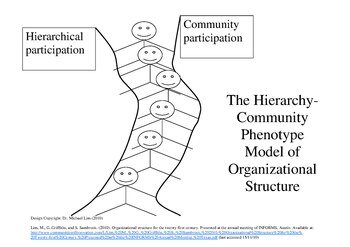
On paper and in textbooks, structure can be broken down into useful archetypes such as the matrix structured organization or the market structured organization. However, even as we unpacked these examples, real work experience showed our interpretation of our own companies as hybrids of these models. Each had little nuances that made it not quite as pretty as the textbook organizational structure. Even more often, it appears that a company structure on paper is as neat as a textbook structure, but in practice, this is not their reality. Just try googling images of orgaizational strucutre, and the massive variety appears. This was a personal favorite.
As we delve into understanding what organizational structure is, and how complicated it can become, I understand more and more how existing corporate structures are influencing my work life. Acknowledging that there are larger forces at play, and that those forces are determined by the architecture in which they were implemented gives clarity around what I need to do differently in order to make change.
I work in a large organization with diverse business offerings divided by business units. We operate with a strong overarching mission highlighting integrated delivery, but the reality of the corporate structure as designed is a heavily siloed approach to projects. Resources are shared vertically, not horizontally across departments, and goals of individual divisions can sometimes hinder the ability of others to perform. Recently I have run into roadblocks where communication does not seem to penetrate the organization, and major links are impossible to connect. With a new academic understanding of how to break down the structure, I feel more prepared to seek out specific leverage points where I can intervene and make those links appear.

Understanding the structure of my organization is only the first step. Now I am becoming aware of the challenges of organizational structure of my clients as well, and it gives me a whole new appreciation for the need to redesign our approach to delivering services to them. I often work with school districts (which will remain anonymous on this blog), working to bridge the gap between facilities and operations and the actual classrooms (curriculum and teachers). This seems like a straightforward task, as the whole district is aligned around the mission of serving students. With a major focus on authentic learning around science and math, building data and interaction with their immediate environment is a natural fit. Everyone is on board with the concept, but the actualization is hindered by the district’s corporate structure.

At the district, divisions are siloed, and no individuals from curriculum have reason to directly collaborate with someone from facilities. Not because they do not see value in it, but simply because their jobs have them reporting to and collaborating with people only from their own divisions. Working across these groups is beyond their job description.  A major hole in this structure is a result of budget cuts, where the mid level managers (who previously had more cross departmental meetings and collaboration) were removed from the structure. However, instead of readjusting the roles to help fill this void, the void just exists, hindering progress since it is no one’s “job” to address.

Interestingly, I learned the most about the inside organizational structure from an adjunct member of the school district bureaucracy. This individual works for an associated foundation, and is possibly the only person to truly have a working relationship with leaders of both departments. Identifying her as a key link in bridging this gap will not only assist her in being more effective (one person trying to bridge organization gaps is rough) but will give me the opportunity to start foraging relationships that can help meet common goals of both groups. The goal here is to eventually help drive long term organizational change to create a more integrated, collaborative culture at the district, which is something that both sides have identified as a goal.

Understanding organizational structure is a fantastic tool for framing problems and diagnosing solutions. Every organization, from a fortune 500 company to a 4 person family has some sort of structure whether it is formalized on paper or simply implied. Stepping back to assess the communication and decision making channels that this structure dictates is a fantastic first step in creating smoother operations and more effective collaboration on any scale.

Sunday, January 27, 2013

A New Way to Measure


Measuring and reporting sustainability is not only a growing trend, but it is a critical part of ensuring that customers and competitors know what a company is doing to move to address today’s concerns about corporate sustainability values. There are tens if not hundreds of “standards” that are used for ranking and measuring company performance, or a subset of the company like how they operate buildings, treat employees etc. A few are well known such as the Global Reporting Initiative (GRI), LEED for buildings, Energy Star for Energy Performance, and dozens of “lists” of top performers. This week on GreenBiz, an article was exploring these lists from an energy company perspective.

Their analysis was focused on the 2013 Global 100 list, the Corporate Knights Inc. list identifying the top 100 most sustainable large-cap companies in the world. Their surprising find? Two of the top five companies on the 2013 Global 100 list are oil and gas companies. For their full explanation of how these ranking stack up, see the article here

I appreciated that the GreenBiz article called out the inconsistencies between these lists. Different lists get different media attention in different market sectors, and in different countries, and each one ranks companies differently.
“… just to show you how crazily inconsistent this list-making business has become, only one of the top 4 companies on Newsweek’s 2012 green global rankings -- Santander Brasil, Wipro, Bradesco and IBM -- made it onto Corporate Knights’ Global 100. And not one of the top 5 on the Corporate Knights’ list made the Newsweek rankings.”

It does not surprise me when I see well known product brands like Clorox on the list; their efforts to make more sustainable products go directly in line with their customer marketing. What really grabs my attention is when industrial businesses, like oil and gas companies, are called out.

It has long been my personal mission to work with and understand these large industrial companies, and how to pivot their business into more sustainable models. This is a huge task, when the core of their business proposition is grounded in something that is in-and-of-itself, not sustainable. The oil and gas companies alone make up 54 of the wealthiest 500 companies in the world, with a combined 2010 value of $4.17 Trillion.  That is a lot of value tied up in a business model founded on a finite resource.

We are learning about developing businesses that are flexible, sustainable, and designed to make the world a better place balancing people, planet and prosperity. Clearly, these non-renewable energy companies are doing fine on the profit side, but what is their long term strategy? Many of these companies are participating in the reporting game, appearing on sustainability lists and reporting to the GRI. Reducing emissions associated with operations, making extraction methods more efficient, highlighting community development and employee benefits. These elements point to a more sustainable company by definition, but do little to address the underlying shift that is needed to move these companies to a truly sustainable business model.

From Shell: “We began reporting voluntarily on our social and environmental performance with the first Shell Report that covered 1997. We do it to be open and honest, and to show how we are contributing to sustainable development.” 

The high tech oil and gas companies have the skill sets and resources to pour into alternative models, but there is little incentive to do that right now. Investment in renewable alternatives are simply side projects, while the core business direction is how to keep producing what we always have, but more efficiently, cleanly and safely. I do not want to downplay the importance of these efforts. They are critical as we do not have a working alternative model at this point and need to carefully use the current models as well as we can. However, making things “better” does not solve the problem.

Until the core business focus shifts, these companies are operating on an unsustainable trajectory. The current system of rankings and reports does not help force this shift. While they continue to appear on lists touting their “sustainable practices”, how are they publicly held accountable? I believe that these reports slow down public demand for urgency to change. I think it is time to add a new metric in sustainability rankings: how sustainable is the underlying business model of the company.

Sunday, January 13, 2013

Where Does Sustainability Fit?


As we kick off our second quarter at BGI, I am struck with a renewed sense of purpose for becoming a thought leader for sustainable business. We are surrounded by examples of “the status quo” and the inability to make decisions about the future. We cannot keep delaying action and pushing off decisions to the next leaders, generations, congress, CEOs etc. We must find people who are passionate NOW, and who are willing to make the tough decisions and stand up to lead our way forward to a more positive future.

My background is environmental science, with an emphasis on the science. I have never taken business classes before, and so all my experience stems from what I have experienced firsthand in organizations I have worked for. It has been fascinating, even just within this first week, to start unpacking the meaning of strategy and organizational structure…and where sustainability fits in to all of this.

The core of my current job is helping organizations start the visioning and planning process to make change; change towards lower emissions, integrated communication, general sustainability, new building designs. I work with a workflow very similar to what was presented in class this week, a process that starts with a vision, ends with action, and emphasizes reiterations and revisiting original goals to track progress. No rocket science here, and it felt like I was just hearing about my daily job. I then heard one sentence that really hit me hard. It was a subtle, slight twist on the traditional vision/goal setting process that made so much sense I have used it in practice three times this week. It is a new way to look at your goal, and it offers much more opportunity for change than “what do you want to be”.

“What would a truly {sustainable, integrated, successful, etc} version of us look like? (from the perspective of what is NECESSARY  not what is FEASIBLE).

Wow. This is a conversation framing changer. I am currently working with a school district to define what a new school would look like, and how the facility can help accomplish it. Only when we started talking about what was necessary did we really start to unpack the true vision (and challenges!) of our task.

That brings me back to the role of sustainability in business. Clearly the organization must hold a vision or nothing will happen. But whose role it is to formulate that vision, and carry it out? We hear so much about the Sustainability Manager or Chief Sustainability Officer (CSO), or the grassroots green team that is making waves in an organization. I would argue that all these models are a great start, but are not the end answer. To me, they do not represent a sustainable organization.

How many businesses have one specific department that is concerned with revenue? Or public perception? Sure, there is the accounting department and public relations, but ultimately a successful business has every P&L on the lookout for revenue, and each project manager or staff member is personally aware and vested in this goal. It is the collective effort of all the individuals that drive revenue, and ultimately the success of the company.

Sustainability must be viewed in the same way. It has to be everyone’s interest, not just the responsibility of one department or individual.  The vision and plan must be integrated throughout the organization, and there must be accountability for progress throughout all levels. If all efforts are directed by a single upper-management role, this could also hinder creativity, and force out great ideas from individuals because it is “not their job”. Sustainable innovation must be part of everyone’s job for the organization to truly move towards a more sustainable future.

The GreenBiz Group just published their third annual “State of the Profession” report, investigating the unique role of the sustainability executive in industry. This immediately caught my eye, as I expect many of my classmates (myself included) see this as a possible career path after BGI. After reading this report, I am inclined to think that the market may be looking for something else by the time my class graduates. 

There were many interesting trends and insights into the sustainability profession. Two key metrics that intrigued me were the fact that more and more total companies now have a full time sustainability manager position, but the number being added each year has been decreasing since 2008. 


 The report goes on to investigate what this means for the future of sustainability positions, and relates it to the experience of current executives and the challenges they face.


If you are interested in what GreenBiz found, check out the report here. And if you just want to know the main takeaway, here is summary excerpt of the three main challenges they found to be facing sustainability managers and executives.
  • There is no natural home for the function. There is no one department that most companies call out as the logical place for sustainability to reside.
  • There is no professional accreditation or degree. Certificate programs and sustainability-themed MBAs have sprouted and are effective in providing context for sustainability executives, but they are not necessarily the end-all of what future sustainability leaders will need to succeed.
  • There is no authority. The most effective sustainability programs h a v e u n equivocal support from the company’s CEO, who holds the entire company accountable. (In optimal circumstances, the CEO’s interest is driven by a mandate from the board of directors.) But most sustainability executives must operate in an environment of consensus building along with a wide range of both qualitative and quantitative measures of success, and even these metrics can shift unexpectedly based on changes in budget, leadership, or organizational priorities.
So where does all this leave me? Excited to learn more! As I continue to expand my understanding of organizational structure, and how different structures relate to sustainability efforts, I am curious to unpack a few solid options for how to most effectively integrate these visions into an organization, and spark change at all levels. Clearly, the market for a sole “sustainability leader” may be dwindling, but I hope that we can make this a mindset for business that it is a necessity, not an option, and that there are many other approaches to its implementation than simply hiring an executive.