Sunday, February 3, 2013

Organizational Structure

As the auto and financial mortgage crisis unfolded over the past few years one main task kept surfacing: restructure the company. In the world of an average citizen, I understood this to be a straightforward task…throw out bad apples, get new management in place, and voila: new organizational structure. I could not have been more naïve. This example from the auto bailout illustrates how challenging it is to shift a corporate structure that is well established, and sometimes not even defined. I particularly appreciated the acknowledgement that the structure being revamped at GM was not even formally written down. This seems to be common in companies that either have a long legacy, or have experienced rapid, diverse growth.

On paper and in textbooks, structure can be broken down into useful archetypes such as the matrix structured organization or the market structured organization. However, even as we unpacked these examples, real work experience showed our interpretation of our own companies as hybrids of these models. Each had little nuances that made it not quite as pretty as the textbook organizational structure. Even more often, it appears that a company structure on paper is as neat as a textbook structure, but in practice, this is not their reality. Just try googling images of orgaizational strucutre, and the massive variety appears. This was a personal favorite.
As we delve into understanding what organizational structure is, and how complicated it can become, I understand more and more how existing corporate structures are influencing my work life. Acknowledging that there are larger forces at play, and that those forces are determined by the architecture in which they were implemented gives clarity around what I need to do differently in order to make change.
I work in a large organization with diverse business offerings divided by business units. We operate with a strong overarching mission highlighting integrated delivery, but the reality of the corporate structure as designed is a heavily siloed approach to projects. Resources are shared vertically, not horizontally across departments, and goals of individual divisions can sometimes hinder the ability of others to perform. Recently I have run into roadblocks where communication does not seem to penetrate the organization, and major links are impossible to connect. With a new academic understanding of how to break down the structure, I feel more prepared to seek out specific leverage points where I can intervene and make those links appear.

Understanding the structure of my organization is only the first step. Now I am becoming aware of the challenges of organizational structure of my clients as well, and it gives me a whole new appreciation for the need to redesign our approach to delivering services to them. I often work with school districts (which will remain anonymous on this blog), working to bridge the gap between facilities and operations and the actual classrooms (curriculum and teachers). This seems like a straightforward task, as the whole district is aligned around the mission of serving students. With a major focus on authentic learning around science and math, building data and interaction with their immediate environment is a natural fit. Everyone is on board with the concept, but the actualization is hindered by the district’s corporate structure.

At the district, divisions are siloed, and no individuals from curriculum have reason to directly collaborate with someone from facilities. Not because they do not see value in it, but simply because their jobs have them reporting to and collaborating with people only from their own divisions. Working across these groups is beyond their job description.  A major hole in this structure is a result of budget cuts, where the mid level managers (who previously had more cross departmental meetings and collaboration) were removed from the structure. However, instead of readjusting the roles to help fill this void, the void just exists, hindering progress since it is no one’s “job” to address.

Interestingly, I learned the most about the inside organizational structure from an adjunct member of the school district bureaucracy. This individual works for an associated foundation, and is possibly the only person to truly have a working relationship with leaders of both departments. Identifying her as a key link in bridging this gap will not only assist her in being more effective (one person trying to bridge organization gaps is rough) but will give me the opportunity to start foraging relationships that can help meet common goals of both groups. The goal here is to eventually help drive long term organizational change to create a more integrated, collaborative culture at the district, which is something that both sides have identified as a goal.

Understanding organizational structure is a fantastic tool for framing problems and diagnosing solutions. Every organization, from a fortune 500 company to a 4 person family has some sort of structure whether it is formalized on paper or simply implied. Stepping back to assess the communication and decision making channels that this structure dictates is a fantastic first step in creating smoother operations and more effective collaboration on any scale.

Sunday, January 27, 2013

A New Way to Measure


Measuring and reporting sustainability is not only a growing trend, but it is a critical part of ensuring that customers and competitors know what a company is doing to move to address today’s concerns about corporate sustainability values. There are tens if not hundreds of “standards” that are used for ranking and measuring company performance, or a subset of the company like how they operate buildings, treat employees etc. A few are well known such as the Global Reporting Initiative (GRI), LEED for buildings, Energy Star for Energy Performance, and dozens of “lists” of top performers. This week on GreenBiz, an article was exploring these lists from an energy company perspective.

Their analysis was focused on the 2013 Global 100 list, the Corporate Knights Inc. list identifying the top 100 most sustainable large-cap companies in the world. Their surprising find? Two of the top five companies on the 2013 Global 100 list are oil and gas companies. For their full explanation of how these ranking stack up, see the article here. 

I appreciated that the GreenBiz article called out the inconsistencies between these lists. Different lists get different media attention in different market sectors, and in different countries, and each one ranks companies differently.
“… just to show you how crazily inconsistent this list-making business has become, only one of the top 4 companies on Newsweek’s 2012 green global rankings -- Santander Brasil, Wipro, Bradesco and IBM -- made it onto Corporate Knights’ Global 100. And not one of the top 5 on the Corporate Knights’ list made the Newsweek rankings.”

It does not surprise me when I see well known product brands like Clorox on the list; their efforts to make more sustainable products go directly in line with their customer marketing. What really grabs my attention is when industrial businesses, like oil and gas companies, are called out.

It has long been my personal mission to work with and understand these large industrial companies, and how to pivot their business into more sustainable models. This is a huge task, when the core of their business proposition is grounded in something that is in-and-of-itself, not sustainable. The oil and gas companies alone make up 54 of the wealthiest 500 companies in the world, with a combined 2010 value of $4.17 Trillion.  That is a lot of value tied up in a business model founded on a finite resource.

We are learning about developing businesses that are flexible, sustainable, and designed to make the world a better place balancing people, planet and prosperity. Clearly, these non-renewable energy companies are doing fine on the profit side, but what is their long term strategy? Many of these companies are participating in the reporting game, appearing on sustainability lists and reporting to the GRI. Reducing emissions associated with operations, making extraction methods more efficient, highlighting community development and employee benefits. These elements point to a more sustainable company by definition, but do little to address the underlying shift that is needed to move these companies to a truly sustainable business model.

From Shell: “We began reporting voluntarily on our social and environmental performance with the first Shell Report that covered 1997. We do it to be open and honest, and to show how we are contributing to sustainable development.” 

The high tech oil and gas companies have the skill sets and resources to pour into alternative models, but there is little incentive to do that right now. Investment in renewable alternatives are simply side projects, while the core business direction is how to keep producing what we always have, but more efficiently, cleanly and safely. I do not want to downplay the importance of these efforts. They are critical as we do not have a working alternative model at this point and need to carefully use the current models as well as we can. However, making things “better” does not solve the problem.

Until the core business focus shifts, these companies are operating on an unsustainable trajectory. The current system of rankings and reports does not help force this shift. While they continue to appear on lists touting their “sustainable practices”, how are they publicly held accountable? I believe that these reports slow down public demand for urgency to change. I think it is time to add a new metric in sustainability rankings: how sustainable is the underlying business model of the company.

Sunday, January 13, 2013

Where Does Sustainability Fit?


As we kick off our second quarter at BGI, I am struck with a renewed sense of purpose for becoming a thought leader for sustainable business. We are surrounded by examples of “the status quo” and the inability to make decisions about the future. We cannot keep delaying action and pushing off decisions to the next leaders, generations, congress, CEOs etc. We must find people who are passionate NOW, and who are willing to make the tough decisions and stand up to lead our way forward to a more positive future.

My background is environmental science, with an emphasis on the science. I have never taken business classes before, and so all my experience stems from what I have experienced firsthand in organizations I have worked for. It has been fascinating, even just within this first week, to start unpacking the meaning of strategy and organizational structure…and where sustainability fits in to all of this.

The core of my current job is helping organizations start the visioning and planning process to make change; change towards lower emissions, integrated communication, general sustainability, new building designs. I work with a workflow very similar to what was presented in class this week, a process that starts with a vision, ends with action, and emphasizes reiterations and revisiting original goals to track progress. No rocket science here, and it felt like I was just hearing about my daily job. I then heard one sentence that really hit me hard. It was a subtle, slight twist on the traditional vision/goal setting process that made so much sense I have used it in practice three times this week. It is a new way to look at your goal, and it offers much more opportunity for change than “what do you want to be”.

“What would a truly {sustainable, integrated, successful, etc} version of us look like? (from the perspective of what is NECESSARY  not what is FEASIBLE).

Wow. This is a conversation framing changer. I am currently working with a school district to define what a new school would look like, and how the facility can help accomplish it. Only when we started talking about what was necessary did we really start to unpack the true vision (and challenges!) of our task.

That brings me back to the role of sustainability in business. Clearly the organization must hold a vision or nothing will happen. But whose role it is to formulate that vision, and carry it out? We hear so much about the Sustainability Manager or Chief Sustainability Officer (CSO), or the grassroots green team that is making waves in an organization. I would argue that all these models are a great start, but are not the end answer. To me, they do not represent a sustainable organization.

How many businesses have one specific department that is concerned with revenue? Or public perception? Sure, there is the accounting department and public relations, but ultimately a successful business has every P&L on the lookout for revenue, and each project manager or staff member is personally aware and vested in this goal. It is the collective effort of all the individuals that drive revenue, and ultimately the success of the company.

Sustainability must be viewed in the same way. It has to be everyone’s interest, not just the responsibility of one department or individual.  The vision and plan must be integrated throughout the organization, and there must be accountability for progress throughout all levels. If all efforts are directed by a single upper-management role, this could also hinder creativity, and force out great ideas from individuals because it is “not their job”. Sustainable innovation must be part of everyone’s job for the organization to truly move towards a more sustainable future.

The GreenBiz Group just published their third annual “State of the Profession” report, investigating the unique role of the sustainability executive in industry. This immediately caught my eye, as I expect many of my classmates (myself included) see this as a possible career path after BGI. After reading this report, I am inclined to think that the market may be looking for something else by the time my class graduates. 

There were many interesting trends and insights into the sustainability profession. Two key metrics that intrigued me were the fact that more and more total companies now have a full time sustainability manager position, but the number being added each year has been decreasing since 2008. 


 The report goes on to investigate what this means for the future of sustainability positions, and relates it to the experience of current executives and the challenges they face.


If you are interested in what GreenBiz found, check out the report here. And if you just want to know the main takeaway, here is summary excerpt of the three main challenges they found to be facing sustainability managers and executives.
  • There is no natural home for the function. There is no one department that most companies call out as the logical place for sustainability to reside.
  • There is no professional accreditation or degree. Certificate programs and sustainability-themed MBAs have sprouted and are effective in providing context for sustainability executives, but they are not necessarily the end-all of what future sustainability leaders will need to succeed.
  • There is no authority. The most effective sustainability programs h a v e u n equivocal support from the company’s CEO, who holds the entire company accountable. (In optimal circumstances, the CEO’s interest is driven by a mandate from the board of directors.) But most sustainability executives must operate in an environment of consensus building along with a wide range of both qualitative and quantitative measures of success, and even these metrics can shift unexpectedly based on changes in budget, leadership, or organizational priorities.
So where does all this leave me? Excited to learn more! As I continue to expand my understanding of organizational structure, and how different structures relate to sustainability efforts, I am curious to unpack a few solid options for how to most effectively integrate these visions into an organization, and spark change at all levels. Clearly, the market for a sole “sustainability leader” may be dwindling, but I hope that we can make this a mindset for business that it is a necessity, not an option, and that there are many other approaches to its implementation than simply hiring an executive.

Sunday, December 9, 2012

Growth, and The Future for our Grandchildren


Our macroeconomics textbook ends its final chapter with a power excerpt from economist John Maynard Keynes written in 1930. Of everything I have read so far, this narrative stuck with me, and has reinvigorated my drive for making changes to our current system. A copy of the full essay can be found here.

Norm wrote about this notion on his blog recently as well; the idea of a zero growth society. Norm states the emerging economies, like those of China, India, Brazil, Russia etc., seek the same levels of consumption that the rich nations of the world enjoy today.  This rich level of consumption and production is more than our planet can provide. Our global consumer culture and the nature of our economic system are predicated on constant economic growth.  In order to address the problem of global warming we will need a different culture and a different economic system.

We cannot continue in the current projection of social value being solely measured by economic growth. At some point we will reach a critical tipping point, and will be forced to explore other endeavors to obtain satisfaction and prosperity in our lives. I know that this movement is happening, particularly among many of my peers and classmates. We are exploring what is really important, and how we can continue to develop as contributing members of society, while balancing that with a sustainable future. 

We at BGI are not alone in this movement. There are many examples of community level actions, like the “Move Your Money” and “bank transfer day” campaigns; widespread efforts to shift millions of dollars from corporate institutions like Bank of America to community-benefiting institutions. Related to this are other “new banking” strategies. Since 2010, 17 states, for instance, have considered legislation to set up public banks along the lines of the long-standing Bank of North Dakota.

But how big is this movement? Those of us that see the need to change these structures are still faced with the challenge of slowing down a massive flywheel that has been cranking along long before any of us were born. The momentum is staggering. Sure, I can move my money into a credit union, and work on supporting local community businesses that will feed back into a smaller scale economy, but what about influencing the bigger picture.

Coal exports are a prime example of people speaking out against the momentum, and struggling to make inroads with the scale of these heavily funded projects. Information is out there. People care. Last week, one of my BGI classmates’ 10 year old daughter, Olive, stood up at a town hall meeting to give a speech on how these coal trains will impact her life. There is a movement on Facebook this week to change your photo to this image opposing coal exports. 

We are seeing public opportunities to share our opinions, but where does that get us? Where in our current culture is the opportunity to shift the momentum to make the shift Keynes spoke of in 1930, where “accumulation of wealth is no longer of high social importance, there will be great changes in the code of morals…the love of money as a possession…will be recognized for what it is, a somewhat disgusting morbidity, one of those semicriminal, semi-pathological propensities which one hands over with a shudder to the specialists in mental disease.”

This is the change we need to make as a society. We can teach and learn and tear apart the textbook understanding of the triple bottom line. We can develop sustainable businesses within our communities, and support those that balance these values. But what needs to happen to promote this larger social change to challenge our economic structures and expectations of growth?

Becoming aware, and recognizing our interactions with these structures in our own experiences are paramount to start the change. We must ask ourselves why we are pursuing what we are, and to what ends. We must clearly understand our goals, and then uncover if our actions are actually leading us in that direction. As Olive Lewis stated so eloquently in her plea to the Spokane community, “is this the best we can do, or are we capable of something greater?” Keynes whole essay is about the social change that needs to occur to impact the future for today's children, like Olive. I hope that we all can start making this progress, and take responsibility for our small contributions to this system. I want is to start this transition, so that future leaders and decision makers can start from a place more innovative from where we stand today.

"Hello. My name is Olive Lewis and I am a 4th grader at Roosevelt Elementary. I live just four blocks from away from the rail road tracks that will carry this coal.

I come from a family of railroad employees, including my papa. My papa is concerned about me breathing in the diesel fumes along with the risk of a spill from hazardous cargo.

I am here because I want to play in the World Cup someday. Soccer is my life, and I've already seen a doctor about my lungs. On days of poor air quality I cannot practice or play outside.

I understand the need for jobs, but they need to be the RIGHT jobs. My neighborhood is full of kids breathing the same air and our future cannot be sacrificed for short term gain.

I researched some studies on the potential impact on the air and general pollution to ship this coal to China, and I want to ask: 'is this the best we can do, or are we capable of something greater?'"

words by Olive Lewis, from the Spokane Riverkeeper


Sunday, December 2, 2012

US Coal to Asia: Globalization in Action


This week we have been focusing on globalization, processes that promote world-wide exchanges of national and cultural resources. International trade has been in existence since the earliest days of international exploration and human interaction. The modern economy moves a multitude of goods across international lines, everything from bananas and wheat to airplanes and cars.
This is a perfect tie to the surge of interest in exporting US coal to Asia, mainly China. As referenced in Norm’s blog, China is the center of globalization today. We are importing large quantities of goods and services from China, to the magnitude of $539 billion in 2011 according to the Office of the United State TradeRepresentative. Exports totaled $129 billion; Imports totaled $411 billion. The U.S. goods and services trade deficit with China was $282 billion in 2011. 
International competitive advantage trade theory would describe the coal trade system as the country with the cheapest, easiest production of coal to be the most competitive in the market. China boasts the world's third largest coal deposits, and leads the world, both in the production and the consumption of coal. The United States on the other hand, is the largest coal market open to foreign investors. Inaddition to being the second largest exporter of coal, the United States is the world's second largest coal producer. So how are recent changes in the coal market now making it competitive to export coals from the US into China and other Asian countries from Pacific Northwest ports?
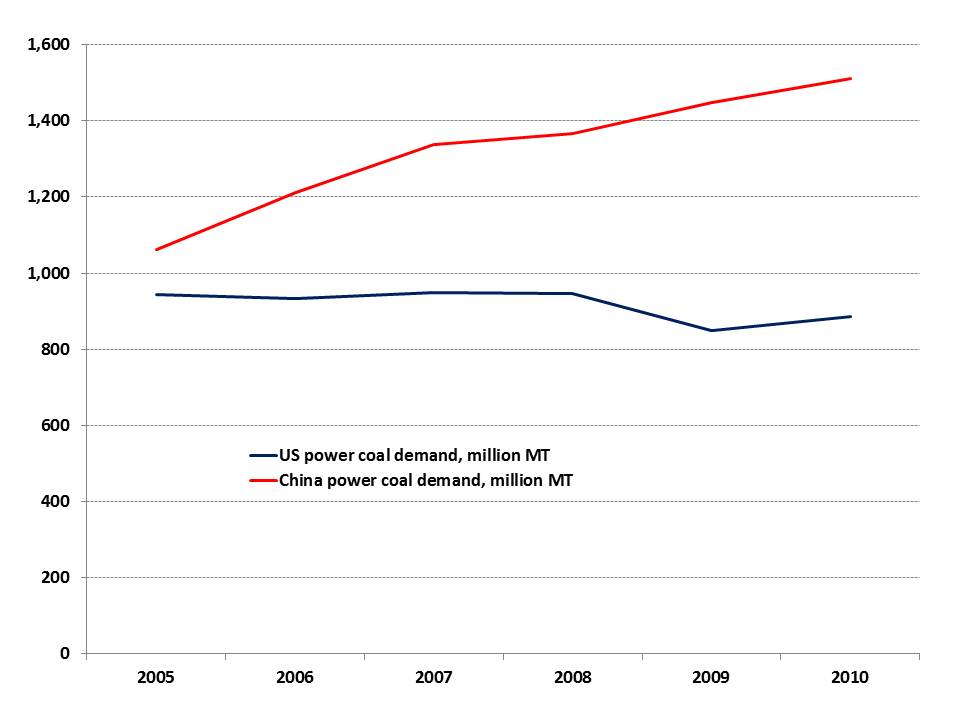
My guess is limited resources globally, couples with an explosion in demand for this energy resource. Coal consumption in China increases at a rate of 10 percent a year, and continues to face challenges of keeping up a domestic supply to meet this demand. This increased demand in China is occurring at the same time the US is seeing a drop in demand domestically. To ensure a long term market is accessible, they see investment in export to China as a longer term project. The U.S. power generation sector saw demand fall by 1% between 2000 and 2010, while demand for coal in China’s electric generation sector surged by 163% during that same time to more than 1.5 billion tonnes per year. 
It is expected that China may import as much as 250 million tonnes of coal during 2012 (coking and thermal coal combined). As such, Wyoming and Montana coal miners have a solid opportunity to market their low-cost, clean burning Powder River Basin coal to power plants in Coastal China.
Foreign investors have become increasingly important in U.S. coal over the past decade or so. The industry is eyeing the region as a hub for export because of its proximity to Asia, said Al Knapp, project manager for Ambre Energy. He said multiple countries, including Japan, which is moving away from nuclear power – are looking to coal as a cheap and reliable energy source. Presently, most coal is shipped from the East Coast.
 “I think there is an opportunity in Asia, and like any good business person would want to do, you go where your market is,” Knapp said. “The Pacific Northwest is the quickest route there.” 
Coal industry experts predict that U.S. exports will surge to more than 100 million tons per year over the coming decade as consumption shifts away from the United States, where electric utilities are relying increasingly on natural gas and other fuel sources for power generation. The coal would go to emerging markets in China, Southeast Asia, India and Latin America where coal remains a primary fuel for electricity.

Even with a booming market, and a large supply of US coal, the export project along the US West Coast is not a fast solution. The string of Pacific Northwest terminals has garnered skepticism and outright opposition from those who believe a massive coal terminal will diminish air and water quality in the region while increasing noise, congestion and wait times at rail crossings. So the actuality of this global coal market may take some time before it is realized from the Pacific Northwest, and other coal exporting countries like Australia, Russia and South Africa may be quicker to respond to this global market. 


Friday, November 9, 2012

Relating Politics and Fiscal Policy…Textbooks and TV


This week, America went to the polls. We voted. And voted for another 4 years with Obama as our leader. Beyond his leadership, we also voted for his fiscal policy…whether we as voters understood/understand that or not. For my entry this election week, I am reflecting on the election and how America understands (or dosen't) fiscal policy when making their choice.

I have always known that I did not understand even a surface scratch about what fiscal policy really meant. I knew it was taxes and government spending, both something that I personally support, but do I really understand why I support these things? Or what they really do? Nope. Taking economics again is opening my eyes to a much larger view of fiscal policy, and what my high level beliefs really do mean in the fiscal policy spectrum…and how hard it is for the average voter to dissect the thinking behind these approaches.

It has been said, over and over for months now, that the #1 issue for voters was the economy, and how our government is either hindering or helping it to recover. This week we covered some very interesting, very basic sets of economic principles that discuss how government spending, taxes, GDP and employment are related. Bottom line, government spending can drive increased aggregate demand which will push the unemployment rate back to a level of higher (and possibly full) employment for the country. Seeing how these ideas relate, and impact each other, show me that my beliefs that taxing and spending are a good thing, even if it raises national debt, and are helping us to avoid another economic collapse.


Changes in government spending, changes in tax levels and changes in transfer payments through programs like social security, all impact income and employment levels, as well as inflation rates. Clearly, with stagnant incomes and a high rate of unemployment, the government should be targeting a fiscal policy that will bring those both up. Expansionary policy, that invests heavily to induce full employment, cannot happen without implementing less popular political moves like raising taxes and borrowing money (debt).


A high level summary of President Obama’s fiscal policy (according to this National Journalreport): Economic stimulus now, deficit reduction over the long term. Tax the wealthy to raise additional revenues. Trim military spending, Medicare, federal pensions, and farm subsidies.

Clearly, this approach is a mix of the three main components discussed above. Both economic stimulus (government spending) is the expansionary policy in action, and the increased tax on the wealthy is the funding source. Another component of boosting up the economy in expansionary fiscal policy is increasing transfer payments, which is not reflected in Obama’s plan to reduce the transfer payment streams listed above.

There are opinions that oppose this expansionary approach with a preference to lower taxes, and lower spending to allow private investment in the market to flourish. However, historical data shows that even in times of reduced taxation, the private investment does not dramatically increase (this articlecited in Norm’s blog expands on the idea further). Through that was what Mitt Romney was promoting for his fiscal policy reasoning.

Through this election, I am curious how much the average voter even understood why the candidate’s policies differed. What is presented to the public are two sentence sound bites to what is a large and complex issue…and dramatically shapes an administration far more than their laundry list of issues. Right now we are in need of dramatic change, and it seems to me that government investment, paid for by us, the people, is the way to move forward. I wonder how the US electorate would vote after everyone took a semester of macroeconomics.

Sunday, November 4, 2012

Job Creation and Unemployment


On Friday, the Bureau of Labor Statistics released its monthly unemployment numbers. “Both the unemployment rate (7.9 percent) and the number of unemployed persons (12.3 million) were essentially unchanged in October, following declines in September.” This was based on household survey data from the US. This number only accounts for persons who are still actively looking for work. It does not count people who worked odd jobs for pay, are underemployed or have become discouraged and stopped looking for work. My sense is that the actual “unemployment rate” would look far worse if we adjusted our metrics to really include the full picture of the working family in America.

We focused on understanding the three main components of unemployment: cyclical unemployment, is due to lack of demand for labor; frictional, which reflects the time it takes to match job seekers with those looking to hire; and structural unemployment, which is a mismatch between the skills in the labor force and the skills needed by firms. In Norm’s blog, he discusses the political arguments that both parties make to force our unemployment numbers to fit more cleanly into one of these categories to assign blame on why unemployment is so high.
So how does this relate back to coal export terminals? Last week’s initial search yielded not a financial statement from Millennium, but rather an economic report published by the company to show its projected positive future impact based on this terminal development. It included many tables and graphs illustrating many variables, including education, current income levels, population statistics, and fiscal expenditures for Cowlitz County. I thought that this document would be interesting to review this week with our economic focus on unemployment, as well as relate to our discussions of environmental justice.
The Millennium terminal in Cowlitz County is a great example of how industrial and environmentally burdensome projects can move into a community, with many local community supporters. According to the report, here are a few key statistics about Cowlitz County.

• Cowlitz County has a population of 102,410
• The largest employment sector in the county is manufacturing, which employs about 20% of the total workforce; construction comprises 8% of total county employment
• In 2010, the county had an unemployment rate of 11.1% and a median household income of $41,000 (in 2012 it was up to 12%)
• County general tax revenues have been hard hit by the recession.  Adjusted for inflation, revenues have declined both in total and on a per capita basis since 2006
• About 52% of workers living in the county are employed within the county; the County has a net job outflow of more than 8,000 jobs


Clearly, the county needs jobs, and the local workforce is skilled for industrial type work. With an unemployment rate higher than the national average, this could be an appealing proposal. A company coming in promising that “state and local benefits will include new and significant jobs, wages, output, and tax revenue. It is also expected that the majority of the positions would be filled from the local labor pool.” What especially when the first publicly published information is about initial jobs: Construction activity is estimated to support 1,350 temporary direct jobs, with an additional 1,300 additional jobs in the related community. However, this rosy and significant number drops significantly after construction stops. The long term estimate of the job creation from this $643M project is 135 direct jobs, and 165 subsequent secondary (indirect and induced) jobs. For a population of over 100,000, that is not a very significant unemployment solution.

For some sections of the community, this proposal’s positive benefits far outweigh the environmental risks. They are focusing on the positive impacts this development could bring, including the cleanup of the brownfield site, more jobs and economicstimulus. “I could see us hiring another large group of workers to come in for good family-wage jobs with benefits,” he said. “That trickles down through the economy. It’s not only a benefit to us, but to local businesses, schools and the tax base.”

For the moment, these two sides are at odds, and working through the NEPA, SEPA and public comment process before any plans are finalized. What jobs will roll out of the final decision will wait to be seen.